

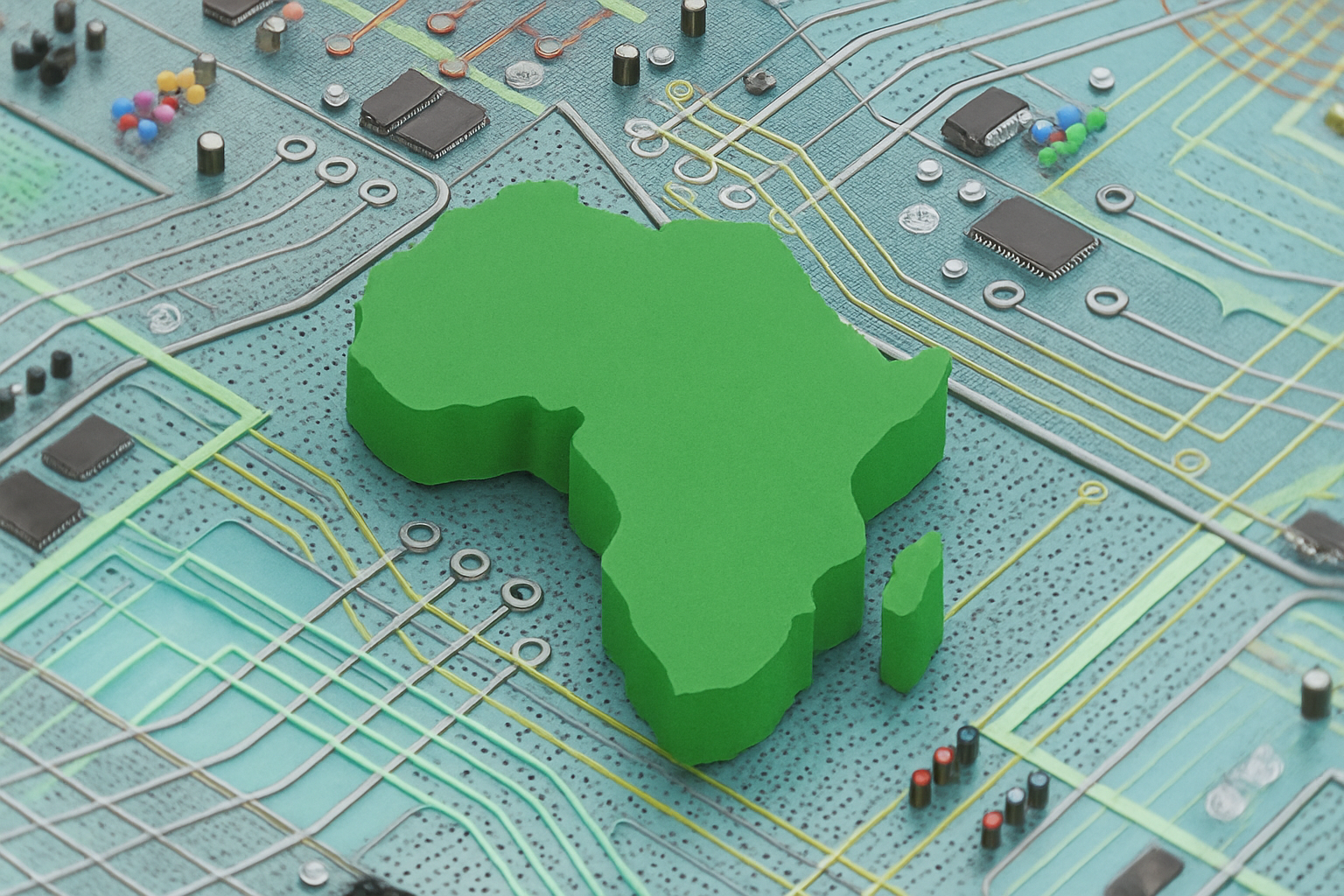
Africa stands at one of the most critical turning points in its long and complex history. For decades, the continent has lagged behind the rest of the world in manufacturing, technological innovation, agricultural modernization, and economic transformation. While other regions accelerated into industrial powerhouses and digital economies, Africa continued to struggle with structural limitations that slowed progress. Now, a new era has arrived—the age of artificial intelligence, automation, self-driving cars, electric vehicles, robotics, and advanced digital systems. The question is no longer just how far behind Africa currently is, but how much further behind it might fall if it does not act urgently to catch up before the AI revolution reshapes the world.
Africa’s challenges today began during the manufacturing age. While nations like China, Japan, South Korea, India, and Vietnam invested heavily in factories, infrastructure, industrial training, and export-driven growth, Africa remained largely tied to raw material exports. Instead of refining its own oil, it exported crude. Instead of producing chocolate, it exported cocoa. Instead of manufacturing electronics, it exported minerals and bought back finished goods at far higher prices. As a result, Africa contributes less than two percent of the world’s manufacturing output today, while China alone produces nearly thirty percent. Manufacturing has always been the foundation of national strength because it creates jobs, supports innovation, expands the middle class, and stabilizes economies. Africa’s failure to industrialize early has left deep scars—high unemployment, economic dependence, and limited innovation capacity. And now that the world is transitioning from traditional manufacturing to AI-powered factories and robotic production, Africa risks missing not just one industrial revolution but two.
The economic landscape reflects a similar pattern. Africa is home to one of the fastest-growing populations in the world, projected to reach 2.5 billion people by 2050. But population growth has not translated into economic power. Many African economies still rely heavily on commodity exports and external loans, making them vulnerable to global price fluctuations and political instability. Meanwhile, countries that dominate the global economy have shifted toward knowledge-based and technology-driven models. Innovation, data, intellectual property, and automation have become the true engines of wealth. Without embracing these new forces, Africa will remain on the margins of global economic influence.
Agriculture, despite Africa’s vast natural potential, also struggles to modernize. The continent possesses 60 percent of the world’s remaining uncultivated arable land, yet spends billions importing food each year. Outdated tools, minimal irrigation, weak storage systems, and vulnerability to climate conditions have held the sector back. Other regions have turned to artificial intelligence, drone technology, automated tractors, and precision farming to increase productivity and sustainability. Meanwhile, many African farmers continue to rely on traditional methods that cannot meet the demands of a growing population. Without adopting modern agricultural technologies, Africa risks both food insecurity and the loss of a massive economic opportunity.
Technology and innovation represent another major gap. Research institutions across Africa remain underfunded, STEM education systems struggle to keep up with global standards, and internet access is often expensive or unreliable. As a result, the continent loses many of its brightest minds to other countries in a persistent cycle of brain drain. While nations around the world are expanding into robotics, biotechnology, cybersecurity, renewable energy, electric vehicles, and space technology, Africa is still working to solve basic challenges such as electricity shortages and outdated school systems. Without substantial investment in digital infrastructure and education, Africa will be locked out of the global innovation economy.
All of these issues become even more urgent with the arrival of artificial intelligence. AI is not simply another invention—it is a global transformation that will determine which countries rise and which fall in the coming decades. Artificial intelligence is already reshaping business operations, healthcare, transportation, education, and agriculture. Smart factories are making decisions in real time, electric vehicles are becoming mainstream, self-driving cars are being tested around the world, and governments are adopting digital systems to manage public services. The benefits of AI are immense: improved productivity, data-driven decision-making, faster development, advanced healthcare, smarter agriculture, and entirely new industries that did not exist a decade ago. Nations that embrace AI will unlock new forms of economic power, while those that ignore it will fall further behind at a pace faster than any previous technological shift.
The question, then, is whether Africa is prepared to compete in this new era. There are reasons for optimism. Kenya has become a global pioneer in mobile money and digital financial services. Rwanda has built one of the most advanced digital governance systems in the world. Nigeria’s tech startups are gaining international attention. Egypt is investing in AI training and research. South Africa is moving ahead with renewable energy and modern technology programs. These examples show that Africa can innovate when given the opportunity. However, progress remains slow compared to the speed at which AI and automation are changing the world.
Other countries are building robotic factories, adopting digital citizenship programs, expanding AI-driven education, and transitioning to electric and autonomous transport systems. If Africa does not accelerate its efforts, it risks being permanently excluded from the industries of the future. Millions of young Africans may enter adulthood without the skills required to survive in a digital, automated world. And without preparation, Africa could become a consumer—not a creator—of future technologies, deepening economic dependency.
Yet Africa’s potential remains enormous. The continent has the youngest population in the world, rich natural resources, vibrant cultures, and a rapidly growing base of creative entrepreneurs. The AI revolution may offer Africa a second chance—a chance to leapfrog old barriers and enter the future directly. Unlike heavy manufacturing, which requires decades to build, AI development relies on skills, innovation, and digital access. If Africa can invest in education, support technology startups, modernize infrastructure, expand digital literacy, and create supportive policies for innovation, it can still compete in the new global era.
The future will belong to nations that master intelligence—human and artificial. Africa must decide whether it will embrace change or remain stuck in outdated systems while the world moves forward. The window of opportunity is still open, but it is narrowing quickly. The decisions African leaders and societies make today will determine whether the continent rises with the new technological age or is left behind once again.
Africa is not defined by its challenges but by its possibilities. And the greatest possibility before us now is the chance to shape our destiny in the age of artificial intelligence.