

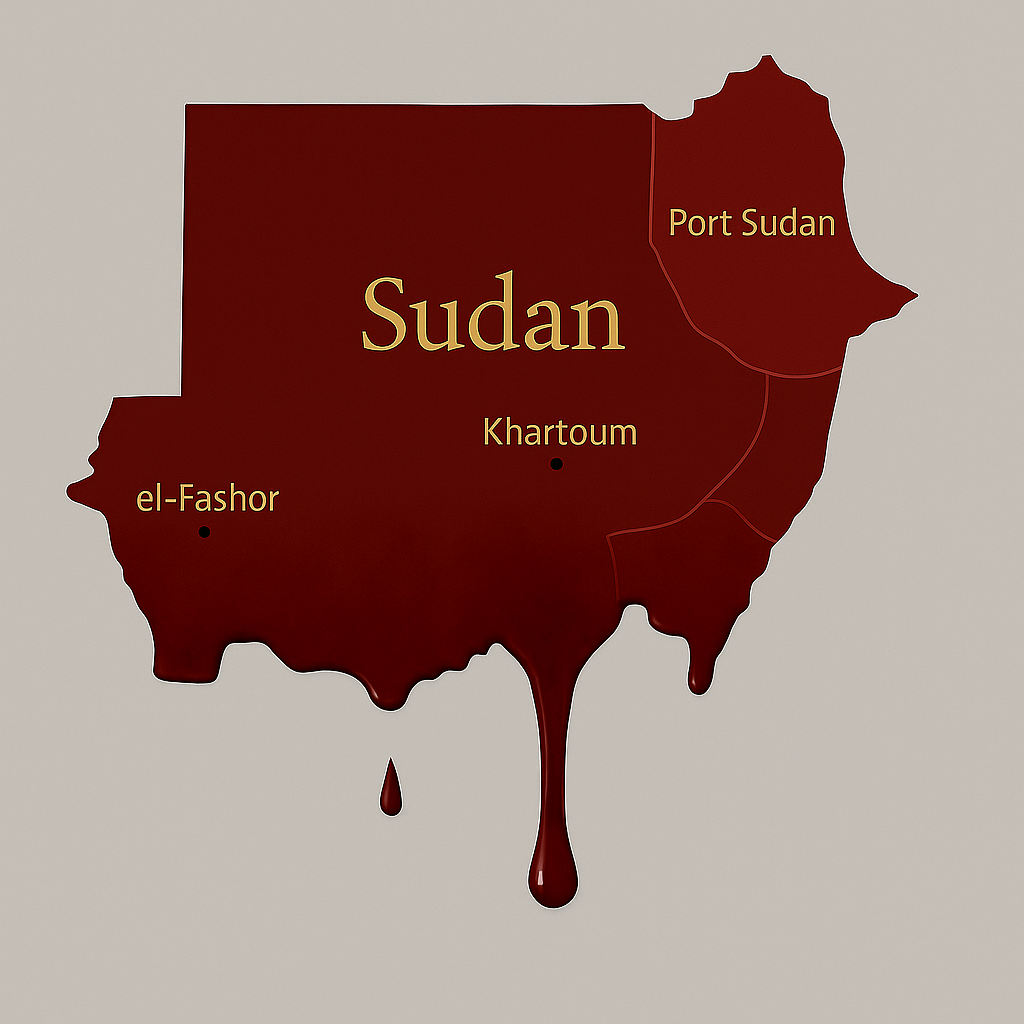
Sudan is bleeding, and the world barely whispers. A nation once filled with promise now lies buried beneath rubble, mass displacement, famine, and unimaginable suffering. It is easy to blame the generals or the militias, but the truth behind Sudan’s collapse runs far deeper. Sudan’s war is not simply an internal struggle—it is a brutal demonstration of how a resource-rich African nation can be torn apart when it lacks political understanding, strategic unity, and strong institutions. Sudan’s tragedy shows what happens when a country overflowing with wealth fails to protect itself from foreign interference, internal fragmentation, and the devastating misuse of its own resources.
At the center of Sudan’s destruction lies a truth that many sense but few openly confront: this war is being fueled from the outside. Sudan’s conflict is not only a power struggle between armed factions—it is a marketplace of foreign ambitions. The United Arab Emirates has been widely accused of supplying weapons, financial support, and logistical channels to factions controlling gold-producing areas. To foreign powers, Sudan is not a nation of 48 million people; it is a map of gold mines, strategic ports, fertile lands, and geopolitical opportunities. Gold that should build schools becomes ammunition. Land that should feed the population becomes a bargaining chip. Ports that could transform East African trade become tools for external strategy. Sudan burns, and someone else profits.
What makes the tragedy even more painful is Africa’s silence. A continent of over a billion people, bound by shared struggle, watches a brother nation collapse with limited meaningful response. The African Union releases statements, regional bodies call for peace, and diplomats meet for photo opportunities—but the actions rarely match the urgency on the ground. Many African governments hesitate to challenge foreign powers fueling the war because they rely on the very same powers for investments, military cooperation, and political legitimacy. This dependency creates paralysis. Africa sees the exploitation occurring in Sudan, yet its response is distant and symbolic. The continent’s silence allows the conflict to deepen and the foreign networks sustaining the war to operate without consequence.
But the deepest cause of Sudan’s downfall is not foreign weapons—it is the absence of strategic understanding within Sudan and across the continent. This is not about basic schooling; it is about grasping how global politics, resource economics, and national development truly work. Sudan, like much of Africa, is rich in natural resources but poor in resource management. It exports raw gold, raw oil, raw minerals—while importing processed goods at higher prices. It loses wealth and gains dependency. This imbalance is not just an economic problem; it is a political and security vulnerability. When a nation cannot control the value of what it owns, others will step in to control it.
Sudan should have been one of Africa’s economic powerhouses. Instead, its gold wealth strengthened militias, enriched foreign traders, and destabilized the state. The country never built the refineries, industries, or technological systems needed to turn raw resources into national power. This is the fundamental problem facing many African countries: natural wealth becomes a curse instead of a blessing when there are no strong systems to manage it.
Africa’s greatest missing resource is not minerals—it is human capital. Natural wealth means nothing without engineers to build factories, scientists to lead research, doctors to strengthen health systems, economists to design sustainable strategies, and leaders who understand geopolitics beyond internal rivalries. The world does not fear Africa’s mines or oil wells; it fears the day Africa learns to refine its own gold, manufacture its own products, and negotiate its own terms. The world benefits when Africa exports raw materials and imports solutions. Sudan’s collapse shows what happens when a nation does not produce the thinkers, innovators, planners, and strategists needed to protect and convert its wealth into progress.
Sudan’s war is the loudest warning yet: resource wealth without strategic knowledge invites exploitation. A nation that does not understand its own power becomes vulnerable to those who do. Sudan’s suffering is a tragic example of what occurs when foreign interests exploit internal weaknesses, when local leaders lack long-term vision, and when a population is not equipped with the political awareness to defend its resources.
Africa must rise with intentional, strategic awareness. It must understand how global powers operate, how to negotiate from a position of strength, and how to build industries that keep wealth at home. Sudan’s tragedy cannot be dismissed as an isolated crisis—it is a continental mirror. It exposes Africa’s systemic weaknesses: dependency, lack of infrastructure, weak institutions, and a failure to develop the technical and strategic talent needed to transform natural wealth into national resilience.
Sudan’s conflict is more than a war. It is a turning point—a message written in blood. It reminds Africa that resources, without strategy, become chains. Influence, without awareness, becomes exploitation. And a people who do not understand the world that shapes them will always be shaped by others.
Sudan’s story is tragic, devastating, and painful. But it is also a lesson that can save the continent if Africa chooses to learn it.