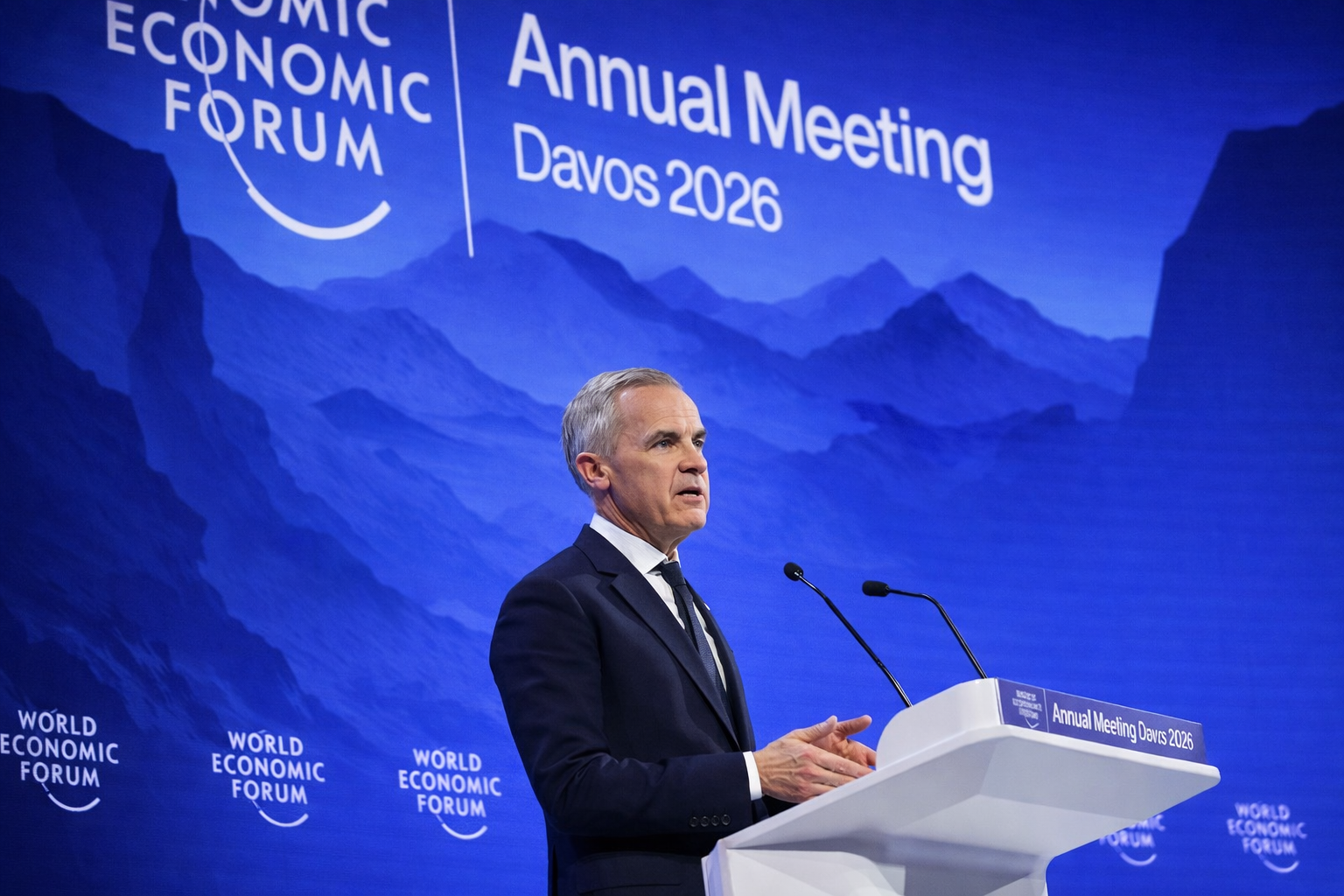
At Davos, the words spoken by Canada’s prime minister reflected more than a national position; they captured a global mood that has been building quietly for years. The message was not openly confrontational, but it was unmistakably clear: the world order that followed the Second World War, led primarily by the United States, is no longer functioning as it once did. It was never entirely fair, and it was often shaped by selective interests and unequal power, yet many countries accepted its flaws because it delivered something rare in human history—relative stability, predictable rules, and economic integration on a global scale.
For decades, the United States stood at the center of a system built on free trade, multilateral institutions, and shared norms. Institutions such as the United Nations, the World Bank, and the broader framework of international law helped connect nations, reduce large-scale conflict between major powers, and facilitate unprecedented global economic growth. Many states tolerated American dominance not because it was neutral, but because the system it led offered tangible benefits: access to markets, security guarantees, and a rules-based environment where even smaller states had some protection against raw coercion.
That tolerance is now eroding.
The current global shift did not begin overnight, but it accelerated sharply during the Trump administration, when the United States openly questioned alliances, withdrew from international agreements, and reframed diplomacy as a series of transactional deals rather than long-term commitments. “America First” signaled a break from continuity, replacing predictability with uncertainty. Allies were no longer treated as permanent partners but as negotiators subject to pressure, tariffs, and public criticism. The repeated threat and use of tariffs against close partners, combined with demands for greater defense spending and political alignment, sent a clear signal that alliance relationships themselves could be leveraged. The implication for the rest of the world was profound: if the leading power no longer felt bound by the rules it helped create, then no rule was truly secure.
This moment exposed a deeper historical pattern. Global orders have always followed power. The Persian Empire unified vast territories through administration and tolerance, but its decentralized system fractured when central authority weakened, allowing provincial elites to act independently and eroding loyalty to the center. Rome imposed law, infrastructure, and trade across continents, yet overextension, economic strain, and internal political instability slowly hollowed out the state’s ability to defend its frontiers and maintain cohesion. The British Empire controlled seas and commerce, exporting institutions that still shape the modern world, but the financial and geopolitical costs of global war revealed the limits of imperial power in an age of industrial conflict and rising nationalism. The United States emerged after World War II not just as a military superpower, but as an institutional architect, embedding its dominance within systems that others could participate in and benefit from.
What made the American era distinct was not the absence of self-interest, but the presence of rules. Power was moderated through institutions. Leadership was exercised through frameworks rather than pure force. That balance is now shifting. As the United States adopts a more nationalist and transactional posture, the global system is moving away from rules and toward leverage, where economic access, security guarantees, and political alignment are increasingly treated as bargaining chips.
Governments across the world have taken notice. Europe, long the closest partner of the United States, is quietly but deliberately pursuing strategic autonomy. This is visible in efforts to strengthen independent defense capabilities, secure energy supply chains, and reduce reliance on any single external power. The language has changed as well. European leaders increasingly speak of resilience, sovereignty, and self-reliance, not as abstract ideals, but as practical responses to uncertainty. When commitments appear conditional and policies can shift dramatically from one administration to the next, dependence itself becomes a strategic risk.
At the same time, Europe is not retreating from global trade; it is redirecting it. Despite growing political and security concerns, many European countries are actively expanding economic engagement with China, particularly in manufacturing, electric vehicles, batteries, and infrastructure. Several governments view trade with China not as ideological alignment, but as diversification—an effort to reduce exposure to unilateral pressure by widening economic options. This approach reflects a broader recognition that economic survival in a fragmented world requires flexibility rather than loyalty to a single center.
Middle powers are also adjusting their strategies. Countries such as Canada and Australia, deeply integrated into the global economy, recognize their vulnerability in a world where economic interdependence is being weaponized. Tariffs, sanctions, and trade restrictions are no longer last resorts; they have become routine tools of statecraft. In response, these countries are seeking new trade relationships and strengthening ties beyond traditional alliances. Canada’s growing engagement with Asian markets, including China, reflects this logic. It is not a rejection of Western partnerships, but an attempt to ensure that access to markets and investment cannot be easily cut off through political pressure.
Trade itself is fragmenting. The era of expansive globalization is giving way to selective integration. Governments are redesigning supply chains around trusted partners while simultaneously maintaining economic ties with multiple power centers. Strategic sectors such as technology, energy, and critical minerals are increasingly shielded, while other areas remain open. Free trade, once promoted as a universal good, is now filtered through national security concerns. This shift does not eliminate trade, but it transforms it into a geopolitical instrument rather than a shared global project.
The most troubling consequence of this transition is the gradual erosion of restraint. When institutions weaken and rules lose authority, power fills the vacuum. In such a world, strong states dictate terms while weaker states face pressure with limited options. International law becomes negotiable. Stability becomes conditional. Cooperation depends less on shared principles and more on alignment with dominant interests.
This is the warning embedded in the Davos speech. The danger is not competition itself, but the normalization of a system where might replaces legitimacy. History suggests that such periods are unstable. When power shifts without agreed frameworks, rivalry hardens, mistrust deepens, and conflict becomes more likely.
The world is not simply entering a post-American era. It is entering an era of uncertainty, where leadership is fragmented, alliances are fluid, and rules are contested. Whether this new world order evolves into a cooperative multipolar system or descends into a hierarchy where strength determines everything will depend on choices being made now—by governments reassessing alliances, by institutions struggling to remain relevant, and by societies grappling with nationalism and fear.
What is clear is that the old assumptions no longer hold. The idea that global stability is guaranteed by a single power, or that economic integration alone can override political divisions, is fading. We are witnessing not the end of history, but its return—marked by power shifts, contested norms, and a renewed struggle over how the world should be organized. In this new era, the central question is no longer who leads the world, but whether power can still be restrained by rules when trust in leadership itself is no longer assured.