

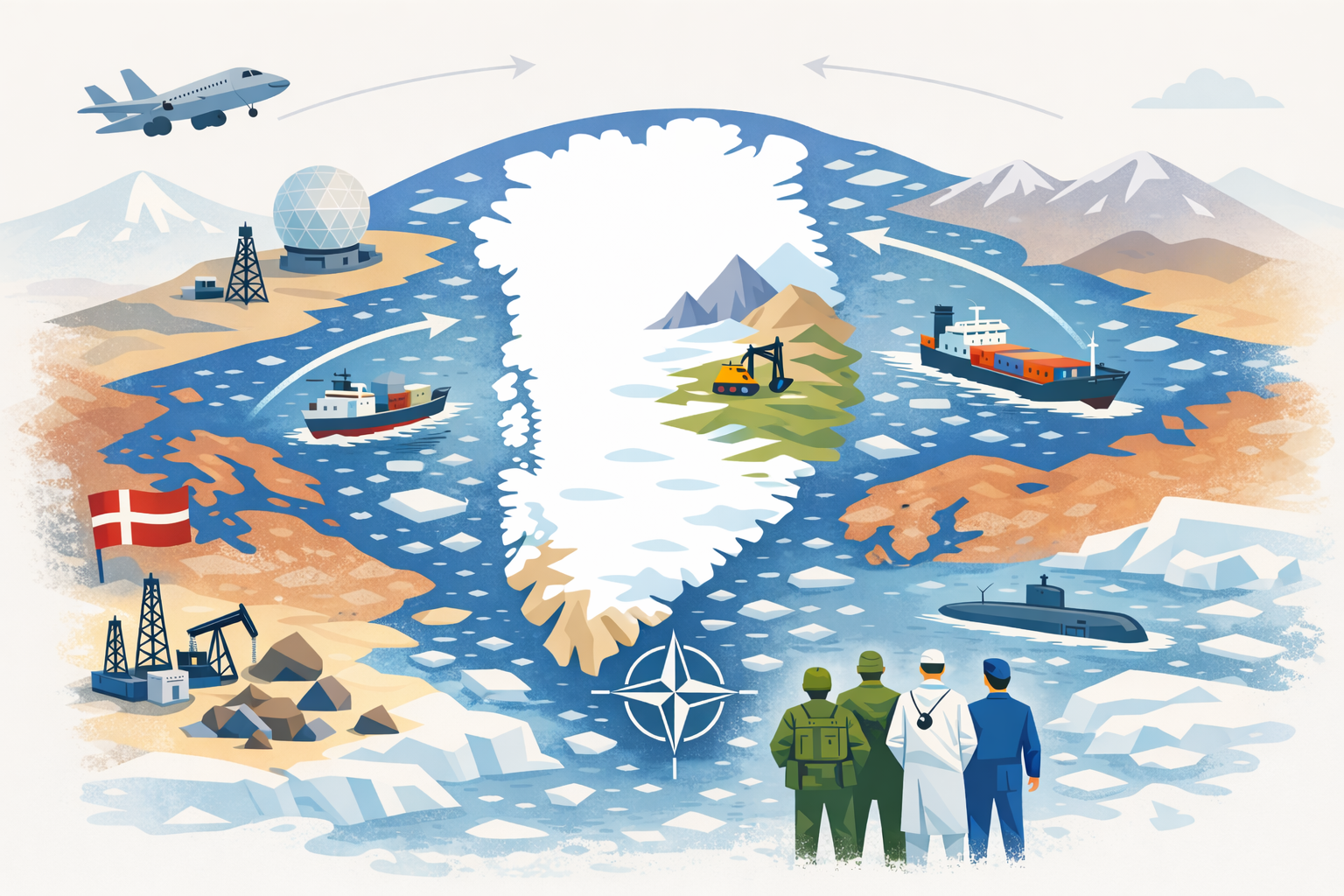
For centuries, Greenland existed on the periphery of world affairs—an immense, frozen landmass known more for its ice sheets than its influence. Today, that perception has changed dramatically. As climate change redraws the map of the Arctic and global power competition intensifies, Greenland has emerged as one of the most strategically important territories on Earth. Beneath its ice lies not only immense natural wealth, but also the future contours of global security, trade, and geopolitical order.
This is not a sudden development. The strategic importance of Greenland has been understood by great powers for more than a century, particularly by the United States, which has repeatedly sought to secure long-term control or influence over the island. What has changed is the urgency. Climate change, technological dependence on rare resources, and renewed great-power rivalry have transformed Greenland from a distant outpost into a central pillar of twenty-first-century geopolitics.
American interest in Greenland predates the Cold War. In the late nineteenth century, shortly after the U.S. purchased Alaska, American officials explored the possibility of acquiring Greenland from Denmark. That interest resurfaced after World War II, when the United States formally offered to buy Greenland in 1946, recognizing its strategic value in the emerging nuclear age. Denmark refused, but Washington retained a military presence and deepened cooperation. Decades later, when Donald Trump revived the idea publicly, the proposal was dismissed as unrealistic—but it reflected a long-standing strategic logic rather than a momentary impulse.
At the heart of Greenland’s importance is geography. The island sits astride the shortest routes between North America and Eurasia, placing it directly along key paths for long-range aircraft and ballistic missiles. During the Cold War, the United States established early-warning radar systems in Greenland to detect potential Soviet attacks. Those systems remain crucial today as missile technology advances and geopolitical tensions re-emerge. In the Arctic, distance is power, and Greenland occupies one of the most powerful positions on the map.
Security concerns alone, however, do not explain the growing attention. Greenland is believed to hold vast reserves of oil, natural gas, and rare earth elements—resources that are increasingly central to global economic and technological competition. Rare earth minerals are essential for electric vehicles, renewable energy infrastructure, advanced electronics, satellites, and modern weapons systems. As nations seek to secure resilient supply chains and reduce dependence on limited sources, Greenland’s resource potential takes on strategic significance far beyond its borders.
Climate change has accelerated all of these dynamics. As Arctic ice melts at unprecedented rates, previously inaccessible resources are becoming reachable, and new shipping routes are opening across the polar region. The Northwest Passage, once blocked by ice, now promises shorter transit times between the Atlantic and Pacific Oceans. Greenland’s proximity to these emerging routes positions it as a future hub for Arctic logistics, monitoring, and economic activity. What was once frozen isolation is rapidly becoming strategic connectivity.
Yet Greenland is not an unclaimed territory in a lawless frontier. It is an autonomous region within the Kingdom of Denmark, and Denmark is a member of NATO. This legal and political reality fundamentally constrains the actions of any external power, including the United States. Under NATO’s collective defense principle, an attack on Greenland would be considered an attack on the alliance itself.
Speculation about a military takeover—however unrealistic—reveals more about the limits of power than its reach. Any attempt by the United States to seize Greenland by force would trigger a profound crisis within NATO, forcing European allies into an impossible position. The alliance’s credibility depends on the principle that collective defense applies equally to all members. Selective enforcement would dismantle the foundation of transatlantic security.
Europe’s response would likely begin with immediate diplomatic unity and condemnation, followed by political and economic consequences that would reverberate globally. Even the closest U.S. allies would be compelled to defend the integrity of NATO and international law. Beyond Europe, such an act would fracture Western cohesion, embolden rival powers, and accelerate the formation of alternative geopolitical blocs. The strategic cost would dwarf any conceivable gain.
For this reason, modern U.S. policy toward Greenland has focused not on ownership, but on influence. Through military cooperation, infrastructure investment, scientific research, and alliance-building, Washington seeks to secure access and stability without violating the rules of the international system it helped create. In the twenty-first century, influence achieved through partnership has proven far more durable than control achieved through force.
Greenland’s rising prominence reflects a broader transformation of global geopolitics. Climate change is reshaping geography, resources are redefining security, and the Arctic is emerging as a new arena of competition and cooperation. Greenland sits at the center of these forces—not as a prize to be taken, but as a strategic actor whose future will shape the balance of power in a warming world.
Beneath the ice lies more than minerals or shipping routes. Beneath the ice lies a test of whether global powers can navigate the new Arctic order without repeating the destructive patterns of the past. Greenland’s future, and perhaps the world’s, will depend on that answer.