

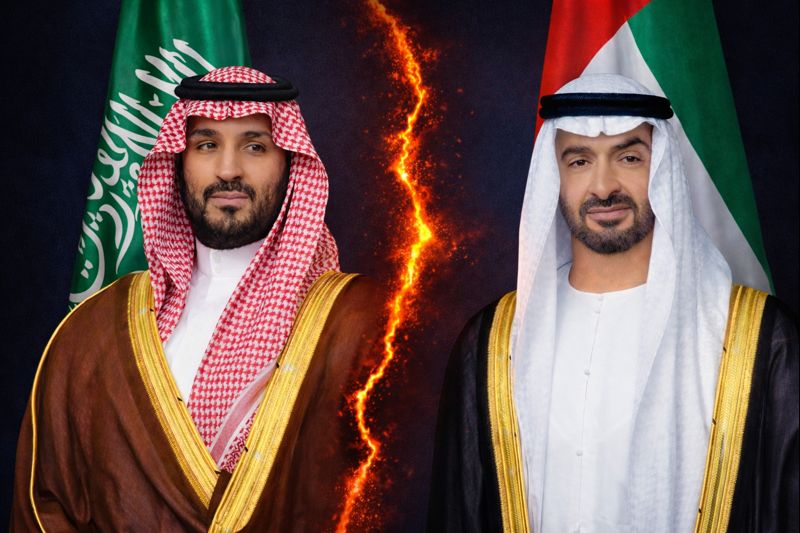
For much of the modern Middle East, Saudi Arabia has occupied a central position as the political, religious, and economic leader of the Arab and Islamic worlds. Alongside Iran and Israel, Saudi Arabia shaped regional balances through its custodianship of Islam’s holy sites, its oil wealth, and its ability to mobilize coalitions across the Middle East and beyond. However, over the past decade, Saudi leadership has faced an unexpected challenge from within the Gulf itself. The rise of the United Arab Emirates as an assertive and strategically sophisticated actor has gradually eroded Saudi influence, exposing structural weaknesses in Riyadh’s approach to regional power.
Historically, Saudi Arabia viewed the UAE as a junior partner—a smaller state with limited population and territorial depth, operating largely under Saudi strategic guidance. This perception shaped Saudi decision-making for years and contributed to a significant underestimation of Emirati ambitions. While Saudi Arabia relied on traditional leadership mechanisms rooted in legitimacy, diplomacy, and consensus, the UAE pursued a different model of power. Abu Dhabi invested heavily in military capacity, intelligence networks, economic leverage, and proxy relationships, allowing it to exert influence disproportionate to its size. Rather than seeking symbolic leadership, the UAE focused on shaping realities on the ground in fragile and conflict-affected states.
This divergence became increasingly evident across Africa and the Middle East. In Somalia, Sudan, and Libya, Emirati involvement often centered on supporting specific armed groups, political factions, or security structures that weakened centralized authority while advancing Emirati strategic interests. Saudi Arabia, by contrast, largely pursued diplomacy and financial support, responding slowly to the cumulative effects of Emirati interventions. Over time, this pattern allowed the UAE to emerge as a decisive actor in multiple theaters that were historically within Saudi Arabia’s sphere of influence.
The most consequential manifestation of this rivalry emerged in Yemen, which became the clearest arena where Saudi and Emirati strategies directly collided. When Saudi Arabia launched its intervention in Yemen in 2015, the primary objective was to restore the internationally recognized government and prevent hostile forces from consolidating power along Saudi borders. While Saudi Arabia focused on the northern front and border security, the UAE concentrated its efforts in southern Yemen. There, Abu Dhabi built and supported local armed formations that later crystallized into the Southern Transitional Council (STC), an entity advocating for southern secession and operating independently of the Saudi-backed Yemeni government.
This divergence eventually evolved into open confrontation. UAE-backed forces clashed with Saudi-aligned factions, seized major southern cities, and undermined the authority of the coalition’s nominal Yemeni partner. Although Saudi Arabia and the UAE remained formal allies, the reality was that Yemen had become a theater of intra-coalition rivalry. Saudi Arabia’s delayed response reflected years of miscalculation, but its eventual actions marked a turning point. Rather than confronting the UAE directly, Saudi Arabia employed military and political pressure against Emirati-backed Yemeni actors, including airstrikes and efforts to marginalize STC leadership. These actions constituted an indirect but unmistakable challenge to Emirati influence and represented Saudi Arabia’s late recognition that the UAE had become a strategic competitor rather than a subordinate ally.
From a Saudi security perspective, southern Yemen holds exceptional importance. Saudi Arabia shares a direct border with the region, and long-term fragmentation there poses a direct threat to national stability. Beyond internal Yemeni dynamics, Saudi threat perceptions increasingly include concerns about external actors gaining access to strategically vital maritime corridors near the Red Sea and the Gulf of Aden. The UAE’s deepening security relationship with Israel has amplified these concerns, particularly as Emirati-aligned territories could theoretically facilitate expanded external influence near Saudi borders. Whether such scenarios materialize or not, the perception itself has reshaped Saudi strategic calculations and intensified Riyadh’s urgency to reassert control over its immediate neighborhood.
The Yemeni case is not an anomaly but part of a broader structural shift in regional power dynamics. Across Africa and the Middle East, the UAE’s strategy of selective intervention, proxy empowerment, and infrastructure control has allowed it to outmaneuver larger states operating through conventional diplomatic frameworks. Saudi Arabia’s reliance on traditional leadership models—effective in an earlier era—has proven less adaptable to fragmented political environments where influence is exercised through networks rather than formal authority.
This evolving landscape presents Saudi Arabia with a fundamental choice. If Riyadh seeks to reclaim its leadership position, particularly within the Islamic world, it must move beyond reactive policies and redefine what leadership means in the contemporary geopolitical context. Leadership can no longer rest solely on religious symbolism or economic scale; it must be demonstrated through the ability to coordinate major Muslim powers, resolve conflicts, and provide tangible regional public goods.
A renewed Saudi leadership strategy would necessarily involve closer alignment with key Islamic states such as Pakistan, Egypt, and Turkey. Rather than pursuing dominance, Saudi Arabia would need to foster a collective leadership model rooted in consultation and shared responsibility. In this framework, Pakistan’s military capacity and humanitarian reach, Egypt’s centrality to Red Sea and maritime security, and Turkey’s diplomatic and mediation capabilities could complement Saudi Arabia’s economic and religious influence.
Yemen itself could become a test case for Saudi leadership credibility. A shift from proxy competition toward political reconciliation, institutional rebuilding, and regional coordination would signal a break from the fragmentation that has defined recent years. Similarly, in Africa, Saudi Arabia could distinguish its leadership by prioritizing state stability, economic development, and multilateral cooperation over narrow security partnerships.
Ultimately, Saudi Arabia’s challenge is not merely the rise of the UAE, but the transformation of regional politics in which agility, strategy, and local influence increasingly outweigh size and tradition. The UAE’s ascent demonstrates how a small state can reshape regional dynamics through calculated, long-term engagement. Saudi Arabia’s delayed awakening in Yemen illustrates the cost of underestimation. Whether this moment becomes a turning point depends on Riyadh’s ability to adapt, coordinate, and lead—not through rivalry alone, but through a renewed vision of collective leadership across the Islamic world.