

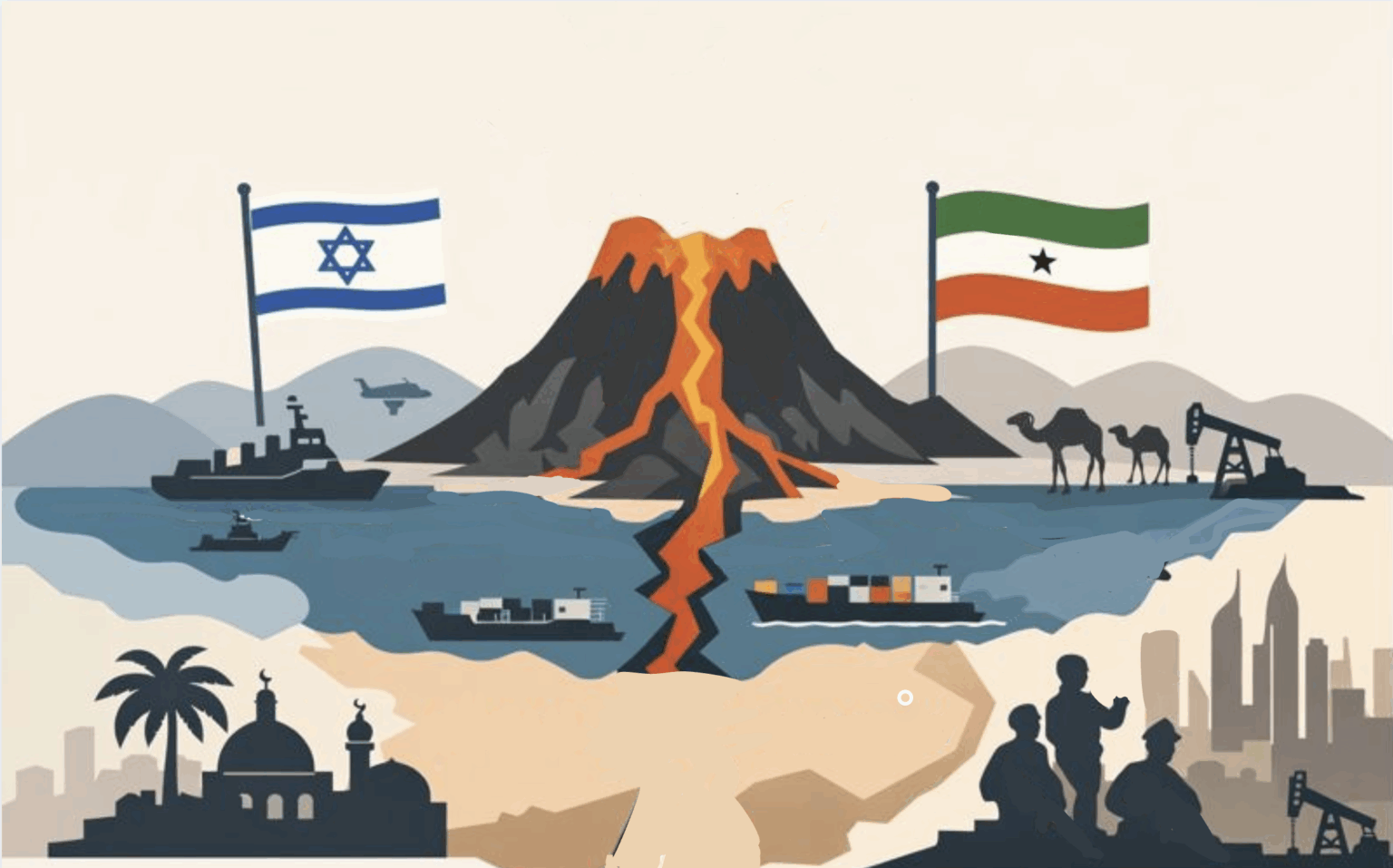
East Africa has entered a decisive geopolitical moment following Israel’s formal recognition of Somaliland as an independent state. What had long been a frozen political question is now an active geopolitical rupture, one that intersects unresolved Somali statehood, Red Sea security, Gulf competition, and great-power calculations. Israel’s decision marks the first time a UN member state has officially recognized Somaliland since it declared independence from Somalia in 1991, and it fundamentally alters the political landscape of the Horn of Africa.
Somaliland has functioned as a de facto independent state for more than three decades. After the collapse of the Somali central government in 1991, Somaliland withdrew from the union and rebuilt its own political system. Since then, it has maintained its own government, security forces, elections, currency, and borders, largely insulated from the prolonged instability that has plagued Somalia. While Somalia struggled with civil war, insurgency, and external intervention, Somaliland cultivated internal order and governance, strengthening its argument that independence is not aspirational but already operational. Despite this longevity and stability, international recognition was withheld, primarily due to the African Union’s doctrine of preserving inherited colonial borders and fears of encouraging secessionist movements elsewhere on the continent.
Israel’s recognition of Somaliland represents a decisive break from that consensus. Recognition transforms Somaliland from a political reality without legal status into a sovereign actor under international law, able to enter formal diplomatic relations, sign treaties, host embassies, and deepen security cooperation. For Somaliland, this is a historic breakthrough after decades of diplomatic isolation. For Somalia, it is a severe geopolitical setback that challenges its territorial claims and weakens its diplomatic standing. Somalia has already rejected the move as a violation of its sovereignty, while the African Union has reiterated its opposition, underscoring the scale of the political fault line now exposed.
Israel’s move cannot be understood outside the strategic importance of the Red Sea. The Red Sea is one of the world’s most critical maritime corridors, linking Europe, the Middle East, and Asia, and serving as a vital artery for global trade and energy flows. In recent years, insecurity in the region, from piracy to regional wars and great-power rivalry, has elevated the Red Sea from a trade route to a strategic battlefield. For Israel, expanding its strategic depth along the Red Sea enhances maritime security, protects shipping lanes, and counters hostile regional actors. Somaliland’s geographic position along this corridor, combined with its pragmatic political posture and lack of ideological hostility, makes it a strategically valuable partner. Recognition, in this context, functions as a geopolitical exchange: diplomatic legitimacy in return for strategic alignment and access.
The implications extend far beyond Israel and Somaliland. The Horn of Africa is already saturated with competing interests from Gulf states, regional powers, and global actors. The United Arab Emirates has invested heavily in Somaliland’s ports, logistics, and security infrastructure, signaling long-term strategic intent. Israel’s recognition increases pressure on other states to reassess their positions. Recognition often follows a domino logic in international politics: once a precedent is set by a strategically significant actor, others with aligned interests may follow, particularly those prioritizing security, trade routes, and regional influence over strict legal norms. The UAE is widely seen as a potential next mover, while the United States may eventually face strategic pressure to adapt if Red Sea security dynamics and allied positions continue to shift.
For Somalia, the broader consequences are profound. Beyond the immediate diplomatic blow, recognition of Somaliland risks accelerating Somalia’s marginalization in regional geopolitics, intensifying internal political tensions, and inflaming nationalist sentiment. It may also complicate security dynamics as external rivalries increasingly intersect with Somali politics. At the same time, Somalia’s continued reliance on historical claims without offering a viable political settlement risks leaving it reactive rather than strategic in an environment that is rapidly evolving.
The Somaliland question has now moved decisively beyond Somali internal politics. It has become embedded in a wider contest over maritime security, regional influence, and global trade routes. East Africa sits atop a geopolitical fault line where local political realities collide with global strategic ambitions. Israel’s recognition of Somaliland has cracked that fault line open. Whether this volcanic shift leads to constructive realignment or destabilizing confrontation will depend on how regional and global actors respond. What is clear is that the old assumptions no longer hold, and the geopolitical ground beneath the Horn of Africa is no longer stable.