
Over the past few weeks, the Somali community has once again found itself at the center of hostile rhetoric, much of it coming from loud but poorly informed conservative voices on social media. The pattern is familiar: target a small minority, inflate fear, and project a sense of power that is more performative than real. One of the main accusations repeated in this cycle is the demand for “assimilation,” often delivered as if it were a moral obligation rather than a complex social process. Yet, those making this demand rarely stop to ask a basic question: what does assimilation actually mean, and into what, exactly, are people being asked to assimilate?
Assimilation, in its simplest sense, refers to the process by which individuals or communities adapt to the social, civic, and economic life of a country. It does not mean erasing one’s identity, abandoning faith, or surrendering culture. Historically, assimilation in the United States has meant learning the language, participating in the economy, respecting the law, and engaging in civic life. It has never required cultural uniformity, and it has never been defined as religious conversion or cultural imitation. The idea that assimilation equals becoming a copy of a dominant group is a distortion rooted more in fear than in fact.
This distortion becomes obvious when people speak loosely about “American culture” as if it were a single, fixed way of life that everyone must adopt. The reality is that there is no singular American culture that unites everyone in the way critics suggest. There is no shared religion, no single ethnic identity, no uniform style of dress, food, or tradition. What the United States actually has are shared principles: the Constitution, which guarantees rights and limits power; the American Dream, which emphasizes hard work, opportunity, and upward mobility; and a way of life built around individual freedom, pluralism, and choice. These are civic ideals, not cultural templates.
When critics demand that Somali Americans “assimilate,” the question becomes uncomfortable but necessary: what do they really mean? Do they mean adopting the religion of white Christians? Dressing in a particular way? Eating foods that are religiously forbidden to others, such as pork? Speaking without an accent? None of these things are requirements of American life, nor have they ever been. They are personal choices, protected by the very freedoms that define the country.
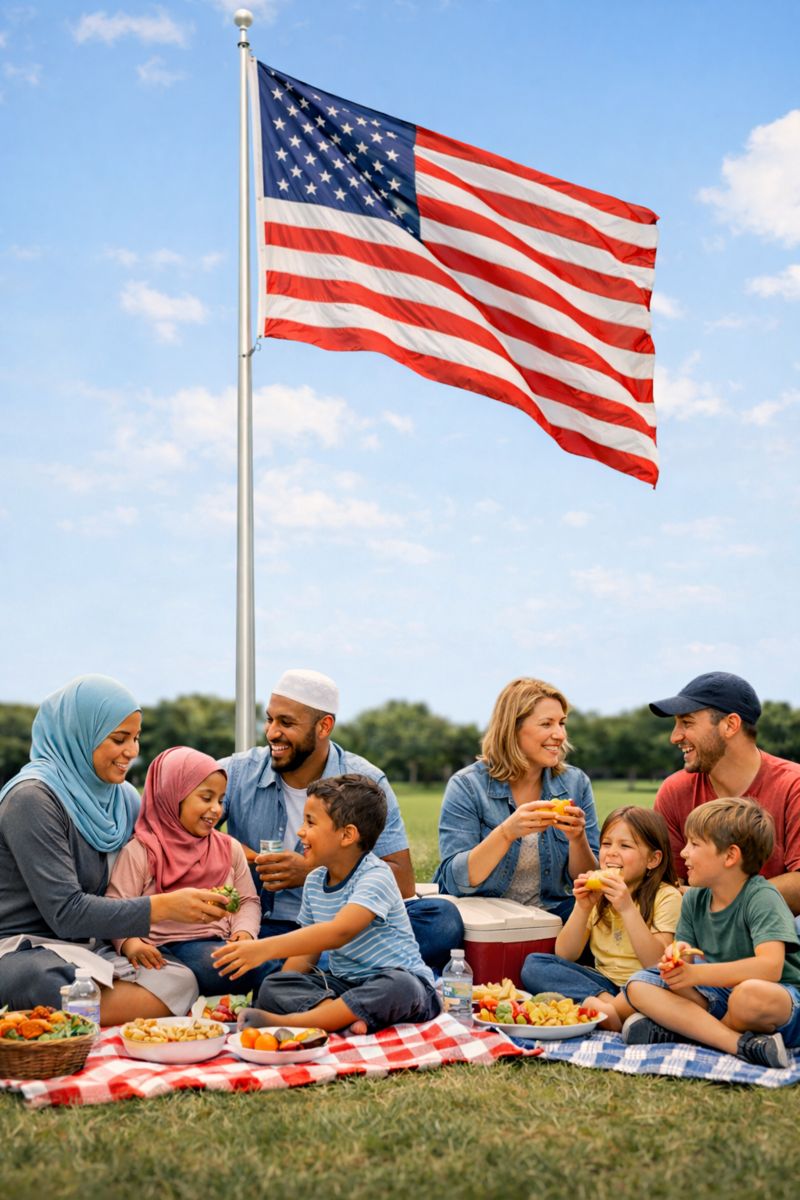
The irony is that the Somali community already exemplifies the core elements of successful integration. Somali Americans are business owners, professionals, students, truck drivers, healthcare workers, engineers, and public servants. They work hard, pursue education, raise families, and contribute economically and socially to their communities. At the same time, they maintain their faith, language, and cultural traditions. This is not a failure of assimilation; it is the American model working exactly as intended.
What Somali Americans do is no different from what other communities have always done. Asian communities preserve language, food, and family structures. Jewish communities maintain religious law and cultural practices. European ethnic groups celebrate heritage, festivals, and customs. Hispanic communities protect language, faith, and identity across generations. None of these groups are accused of being un-American for doing so. Selective outrage reveals that the issue is not assimilation but discomfort with visible difference.
The rhetoric coming from certain conservative circles is not new. It echoes an old colonial mindset that equated power with cultural domination and treated difference as a threat to be controlled. In the past, such language was normalized through coded terms and institutional force. Today, it survives mostly online, stripped of credibility but amplified by algorithms and grievance politics. The idea that forcing people into one “way of life” creates unity is outdated and dangerous. Modern societies are built on consent, not coercion, and on shared rules, not shared identities.
What is particularly troubling is how easily this rhetoric slips into intimidation and panic-mongering. Accusations of non-assimilation are used as a tool to question belonging, loyalty, and legitimacy. This is an old playbook, and it fails because people today are educated, connected, and capable of making their own choices. Threatening communities with vague cultural accusations does not strengthen a nation; it exposes the insecurity of those making the threats.
America’s strength has never come from sameness. It has come from a constitutional framework that allows difference to coexist under shared laws, shared rights, and shared responsibilities. Assimilation, properly understood, means participation, not surrender. It means contributing to society without being forced to abandon who you are. Any vision of America that demands cultural erasure is not a defense of American values; it is a rejection of them.
If the conversation about assimilation is to be honest, it must start with clarity. America does not ask people to become something else. It asks them to believe in freedom, respect the law, work hard, and allow others the same dignity they claim for themselves. Anything beyond that is not assimilation. It is fear, dressed up as authority, using an old language that no longer fits the world we live in.