
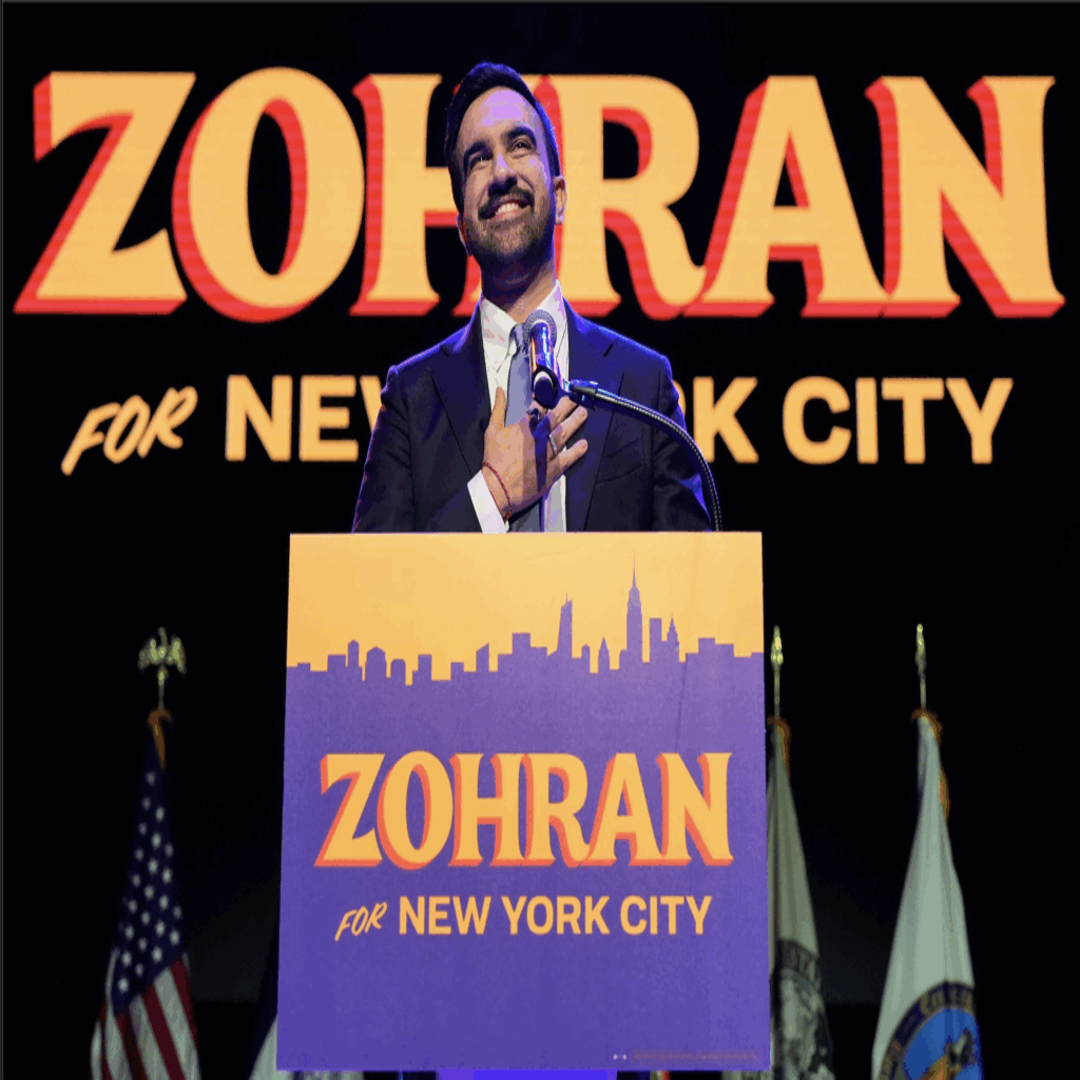
In a stunning political upset, Zohran Mamdani has been elected the new Mayor of New York City, becoming the city’s first Muslim, first South Asian, and youngest mayor in more than a century. His victory is not just a historic milestone for representation—it’s a blueprint for how people-centered politics can overcome the machinery of money, power, and prejudice.
Mamdani’s campaign was a masterclass in grassroots organization, clarity of message, and authenticity. While many candidates in recent years have tried to speak to the “middle class,” few have done so with the depth of empathy and conviction that Mamdani displayed. He built his campaign from the ground up, mobilizing volunteers, community organizers, and first-time voters across the city. His message was focused on one simple truth: life in New York has become unaffordable for ordinary people, and the city’s leadership must put working families first.
Unlike traditional campaigns centered on vague promises or slogans about law and order, Mamdani spoke directly about the cost of everyday living—the price of rent, groceries, transit, and childcare. His proposals were practical and bold: a citywide rent freeze, fare-free buses, city-run grocery stores to stabilize food prices, and universal early childcare for every family. These ideas resonated deeply in a city where millions feel squeezed between stagnant wages and skyrocketing costs. His message was clear: a city worth living in should also be a city worth affording.
But his victory did not come easily. As a Muslim of South Asian descent, Mamdani faced layers of skepticism, coded prejudice, and questions about his “fit” for the city’s top job. Some critics used his faith and foreign-born heritage as a political weapon, while others doubted whether his progressive ideas could realistically work in New York’s complex system. Even within his own party, Mamdani found himself at odds with establishment figures who saw his economic agenda as too radical and his independence as a threat to the status quo. Yet, every attack only strengthened his appeal. He refused to hide who he was or water down what he believed. Instead, he leaned into his story—born in Uganda, of Indian heritage, raised in New York—and connected his personal experience to the struggles of everyday residents.
By embracing transparency and authenticity, Mamdani turned his background into a strength. He reminded New Yorkers that the city’s greatness has always come from its diversity, from people who came from elsewhere to build something better. His voice was not that of a distant politician but of a neighbor who understood what it feels like to juggle bills, rent, and the dream of a fair life. That authenticity became his most powerful weapon.
Mamdani also faced fierce resistance from the city’s economic elite—real estate magnates, billionaires, and lobbyists who feared his promises of higher taxes and greater accountability. They poured money into campaigns against him, painting him as too idealistic or inexperienced. But his response was fearless. “If the rich are scared,” he told a rally crowd, “it means the people are finally being heard.” This defiant honesty turned the attacks into fuel, drawing in even more support from voters tired of seeing City Hall serve developers instead of residents.
The turning point came when Mamdani began framing affordability not as an abstract policy issue, but as the defining moral question of New York’s future. He spoke about housing as a human right, not a commodity. He described childcare as infrastructure, not a luxury. He argued that public transit should serve people, not profit. By doing so, he transformed economics into empathy—and empathy into political power.
In neighborhoods from Queens to the Bronx, his message cut across race, religion, and class. Immigrant families, renters, teachers, small business owners, and even disillusioned young professionals found common cause in his vision of a fairer city. He didn’t just win progressives; he won those who simply wanted a chance to live and thrive in the city they love. For them, Mamdani wasn’t just a candidate—he was a mirror of their struggles and a promise of hope.
What makes his victory even more remarkable is that he managed to challenge both the opposition and the establishment within his own party. He proved that one can stand against the influence of big money and still win by standing with the people. Critics called his agenda unrealistic, but he countered that the most transformative changes in New York’s history—public schools, labor rights, affordable housing—were all once dismissed as impossible. “Every reform starts as a fantasy,” he said, “until the people make it real.”
Mamdani’s victory carries lessons far beyond New York City. It shows that authenticity still matters, that moral courage still resonates, and that economic fairness can unite people in ways ideology cannot. His campaign demonstrated that grassroots organizing, when done with sincerity and vision, can outmatch corporate spending. It reminded voters that hope is not naïve—it is strategic. When people believe again, they show up. And when they show up, they win.
As he prepares to take office, Mamdani faces enormous expectations. Governing a city as complex as New York will require compromise, discipline, and ingenuity. But regardless of how the next few years unfold, his campaign has already changed the narrative of what is possible. He has proven that a candidate can win by speaking to people’s real lives, by challenging the rich and powerful, and by embracing—rather than concealing—his identity and convictions.
Zohran Mamdani’s story is more than an electoral triumph; it’s a movement built on empathy, justice, and courage. His victory reminds us that leadership isn’t about pedigree or privilege—it’s about purpose. It’s about telling the truth when it’s inconvenient, standing firm when it’s unpopular, and believing that a city’s heart still beats in the neighborhoods where ordinary people work, dream, and struggle.
In a time when politics often feels cynical and disconnected, Mamdani’s campaign reignited faith in democracy’s most basic promise: that the people can still take their city back. As he said on election night, “This city belongs to the people who build it, clean it, teach it, and drive it. We’re just taking it back.”
That line may go down as more than a victory speech—it may become the defining philosophy of a new political era in New York, one built not on fear, but on fairness.