
Every nation that seeks to survive in an international system defined by competition, power, and interests develops a foreign policy rooted in strategy rather than sentiment. Serious states invest in research, convene scholars and diplomats, consult security and legal experts, and debate long-term national priorities before defining their external relations. Countries categorize the world not by emotion, but by interest—distinguishing allies, rivals, competitors, and non-aligned partners.
This is where Somalia has repeatedly failed.
Somalia’s foreign policy has too often been shaped by emotional language— “brotherly nations,” religious affinity, or short-term political convenience—rather than sober strategic calculation. While shared culture or faith may inform diplomacy, they cannot replace realism in an international system where states act primarily to advance their own power, security, and influence. The consequences of this failure are now visible, particularly in Somalia’s troubled relationship with the United Arab Emirates.
Several years ago, Somalia granted the UAE extraordinary authority inside its borders under the banner of security cooperation. This authorization extended far beyond standard bilateral agreements. The UAE was permitted to train Somali forces independently, import weapons, engage directly with federal member states, and operate security arrangements that bypassed the federal government in Mogadishu. These actions weakened national sovereignty, undermined constitutional authority, and deepened political fragmentation.
At the time, there was no serious national debate. Parliament was sidelined. Experts were not consulted. No comprehensive assessment was conducted to determine how such agreements aligned with Somalia’s long-term interests. Basic questions—questions that every functional state asks—were ignored: What leverage are we giving up? Who controls the chain of command? And what happens when regional politics shift?
The current confrontation between the Federal Government of Somalia and the UAE did not emerge suddenly. It is not an accident, nor is it a misunderstanding. It is the predictable outcome of years of institutional weakness, poor judgment, and a foreign policy driven by impulse rather than structure.
A critical part of this failure lies in how Somalia negotiates and signs international agreements.
In established states, foreign policy agreements follow a clear chain of command. Negotiations begin at the technical level, where diplomats, legal experts, security officials, and policy advisers conduct preliminary discussions. These teams identify risks, define red lines, and draft frameworks aligned with national interests. Their findings are then elevated to higher levels—inter-ministerial committees or the cabinet—where political, legal, and security implications are debated. Only after this process does an agreement reach the final stage, where it is formally approved by the cabinet and endorsed by the president or relevant ministry.
This structure exists to protect sovereignty, ensure accountability, and preserve institutional continuity beyond individual leaders.
In Somalia, this chain of command has repeatedly collapsed.
Ministers have traveled abroad and signed binding agreements that were never discussed at the technical level, never reviewed by legal or security experts, and never approved by cabinet or parliament. In some cases, presidents themselves have signed major agreements without consulting advisers or institutions. Decisions with long-term national consequences have been reduced to personal initiatives, shaped by urgency, pressure, or political calculation rather than strategic analysis.
This breakdown explains how Somalia was able to grant the UAE sweeping security permissions without a clear legal framework or national consensus. It also explains why those agreements later became sources of conflict rather than stability. When agreements lack institutional backing, they lack legitimacy—and when leadership changes or regional rivalries intensify, such agreements unravel.
The UAE, like all states, acts according to its interests. It is a regional power seeking influence across the Red Sea and the Horn of Africa, control over maritime routes, and leverage in regional security architecture. Its involvement in Somalia must be understood within this strategic context, not through emotional narratives of fraternity.
Somalia’s leadership bears responsibility for enabling this influence. When sovereignty is diluted, consequences follow. When authority is fragmented, external actors adjust accordingly—negotiating with individuals instead of institutions and exploiting internal divisions.
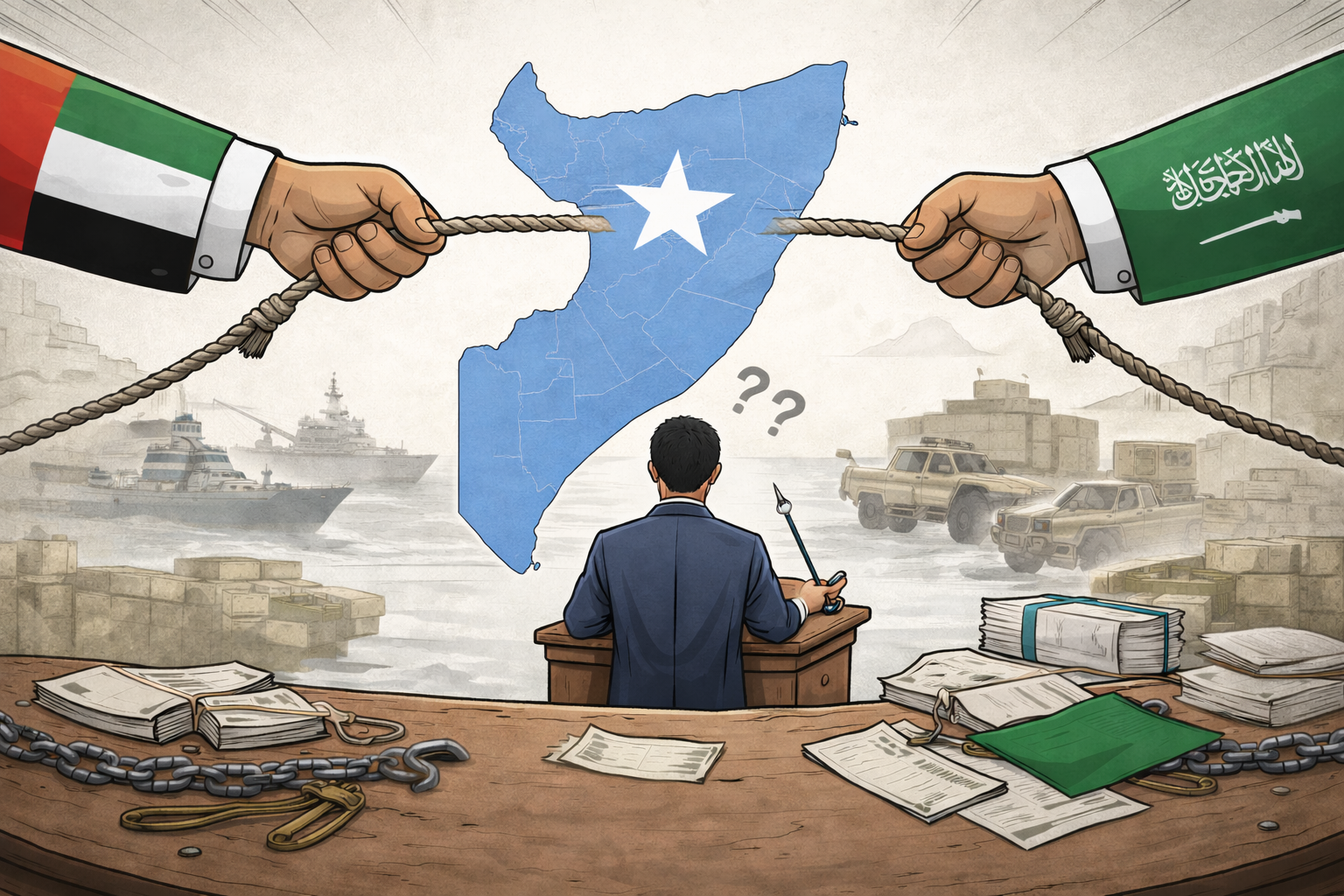
The dispute with the UAE is also inseparable from broader Gulf politics. The rivalry between the UAE and Saudi Arabia, particularly after the Qatar crisis, reshaped alliances across the Horn of Africa. Somalia’s eventual decision to distance itself from the UAE was not driven by a sudden realization of past mistakes, but largely by pressure from Saudi Arabia and its allies. This again highlights Somalia’s reactive foreign policy—decisions shaped by external pressure rather than internal strategy.
The security agreements with the UAE produced tangible harm. They undermined centralized command over armed forces, empowered regional authorities at the expense of federal institutions, and weakened Somalia’s already fragile state-building process. In a country struggling to establish unity and legitimacy, such arrangements deepen division rather than enhance security.
Somalia cannot afford a foreign policy based on gratitude, emotion, or short-term survival. The international system does not reward innocence. It rewards preparation, discipline, and institutional strength.
A credible Somali foreign policy must begin with a fundamental shift in mindset. Somalia must clearly define its national interests: territorial integrity, centralized authority over security, balanced regional relations, and non-alignment in rivalries that do not serve Somali goals. All agreements must be transparent, institutionally reviewed, and subject to parliamentary oversight. No minister should bind the state unilaterally. No president should act without consultation. And no foreign power—regardless of shared religion or history—should be granted unchecked authority within Somali borders.
The lesson from the Somalia–UAE fallout is not that Somalia chose the wrong ally. The lesson is that Somalia failed to act like a state.
Until Somalia replaces emotional diplomacy with strategic realism and restores a disciplined chain of command in foreign policy decision-making, it will remain vulnerable to external manipulation. Sovereignty is not declared in speeches—it is protected through institutions, foresight, and responsible statecraft.